Knox vs Growatt inverters
Which Solar Inverter Is Better for Your Home in Pakistan?
As solar power continues to grow across Pakistan, the choice of inverter has become one of the most important decisions for homeowners and businesses. Among the many brands available, Knox and Growatt are two of the most discussed names. Both promise reliability, efficiency, and affordability, but each has its own strengths and weaknesses. This blog compares Knox and Growatt in detail to help you decide which inverter suits your needs best.
1. Brand overview
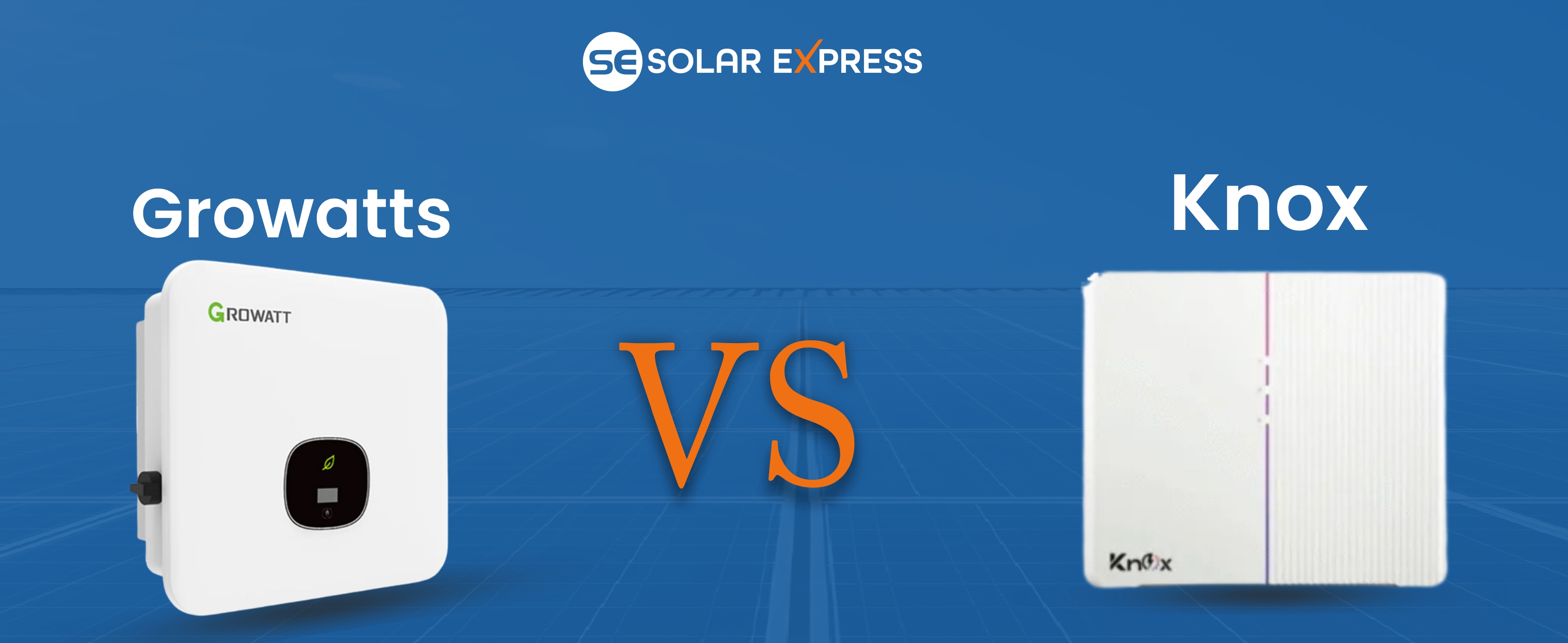
Knox is a local Pakistani brand introduced by Electro Industries in Faisalabad in 2020. Despite being new, it has gained popularity because of its focus on the local market. The brand designs its inverters to handle Pakistan’s voltage fluctuations, high temperatures, and frequent load variations. Knox offers on-grid, hybrid, and off-grid models, and has set up service centers in major cities such as Islamabad, Lahore, and Faisalabad. The biggest advantage for Knox users is easy access to technical support and spare parts through its local “Knox Care Centers.”
Growatt, on the other hand, is an established Chinese manufacturer known worldwide for its high-quality and efficient solar inverters. Founded in 2010, Growatt operates in over 150 countries and is among the top global inverter producers. The brand has a solid reputation for innovation, durability, and energy efficiency. Growatt’s focus is on hybrid and smart solar systems, offering options for both residential and commercial use.
2. Product range and technology
Knox produces a wide range of inverters suitable for different energy setups. Its product line includes the Knox 5G On-Grid series for direct grid connection, the Knox Hybrid series for systems that use both solar and batteries, and off-grid models for remote areas. The inverters feature MPPT technology, LCD display screens, and basic Wi-Fi monitoring options. Since Knox is locally assembled, it often integrates both in-house and imported components to balance cost and performance.
Growatt’s product portfolio is broader and more technically advanced. The company offers string inverters, hybrid models, and energy storage systems. Its popular models like the Growatt MIN and SPH series are known for high conversion efficiency, smart monitoring through Wi-Fi, and compatibility with lithium-ion batteries. Growatt’s inverters have an efficiency rating of up to 98.4 percent, which means more power output from the same amount of sunlight. The company’s mobile apps, ShinePhone and ShineServer, allow users to monitor production, track performance, and receive fault alerts remotely.
3. Efficiency and performance
When it comes to energy efficiency, Growatt has a clear edge due to its extensive R&D and international testing. Its inverters perform well in both bright sunlight and low-light conditions, providing stable output even during cloudy hours. This makes Growatt ideal for hybrid setups where consistent performance is crucial.
Knox performs well for typical grid-tie installations in Pakistan. While its efficiency numbers are slightly lower than Growatt’s, the difference is not dramatic for average users. Knox inverters are tuned for Pakistan’s power grid, which can experience fluctuations and heat stress. As a result, they offer dependable output for local residential and small-business solar systems.
4. After-sales service and support
Knox has the clear advantage of local service support. Because it is a Pakistani brand, customers can directly reach Knox service centers for troubleshooting, warranty claims, or spare parts. Repairs and replacements are often quicker, reducing system downtime. This local presence adds real value for users who prefer immediate support.
Growatt offers international warranty coverage, typically five to ten years, depending on the model. However, its support in Pakistan depends on local distributors and importers. While most distributors are reliable, the process for warranty claims can take longer since parts may need to be imported. Users who prioritize fast response and in-person support may find Knox more convenient, while those looking for long-term warranty security may prefer Growatt.
5. Price and overall value
Knox inverters are generally more affordable because they are locally assembled. The price of a typical 5 kW Knox inverter can be 15 to 25 percent lower than a similar Growatt model. For customers looking for a budget-friendly option that still delivers solid performance, Knox is a practical choice.
Growatt inverters are more expensive, but they justify the higher cost with higher efficiency, better technology, and hybrid compatibility. Over time, the improved efficiency can translate to better returns on investment, especially for larger systems that include energy storage. In short, Knox offers value through affordability and service convenience, while Growatt offers value through long-term performance and advanced technology.
6. Reliability and warranty
Growatt’s reliability record is proven through thousands of installations worldwide. The company provides a standard five-year warranty, with the option to extend it to ten years in some regions. Its products meet international standards such as CE and TÜV certifications, ensuring quality and safety.
Knox offers a three- to five-year local warranty, depending on the model and supplier. Since it’s a newer brand, long-term performance data is still limited, but early user feedback in Pakistan has been mostly positive. Customers appreciate the brand’s quick service response and local availability of spare parts.
7. Monitoring and user experience
Both Knox and Growatt provide smart monitoring solutions. Growatt’s ShinePhone and ShineServer applications allow users to access real-time performance data, historical energy generation, and fault alerts directly on their phones. The interface is user-friendly and designed for both homeowners and installers.
Knox provides local monitoring via display screens and compatible Wi-Fi modules. Although not as sophisticated as Growatt’s system, it serves the basic purpose for users who just want to track system output and performance. Growatt has a slight advantage here because of its more polished app experience and better data analytics.
8. Installation and compatibility
Installers in Pakistan are familiar with both brands. Growatt systems are often chosen for hybrid setups with battery backup, while Knox is more commonly used in grid-tie systems without storage. Both inverters are compatible with most leading solar panel brands available locally. The key difference is that Growatt offers more flexibility for future expansion, such as adding batteries later, while Knox provides a simpler, plug-and-play setup for immediate use.
9. Final verdict
Choosing between Knox and Growatt depends on your priorities. If you want a reliable, locally supported inverter at a reasonable price, Knox is a strong option. It performs well in local conditions, has quick service availability, and suits most residential and small commercial setups.
If your focus is on maximum efficiency, hybrid features, and long-term reliability, Growatt stands out as the better choice. It is globally tested, technologically advanced, and ideal for users planning to expand their system with battery storage in the future.
For most Pakistani users, Knox is the practical and cost-effective choice for grid-connected systems, while Growatt is best suited for those who want a premium, future-ready solar power setup. Either way, both brands contribute positively to Pakistan’s growing renewable energy landscape.
Related Articles